
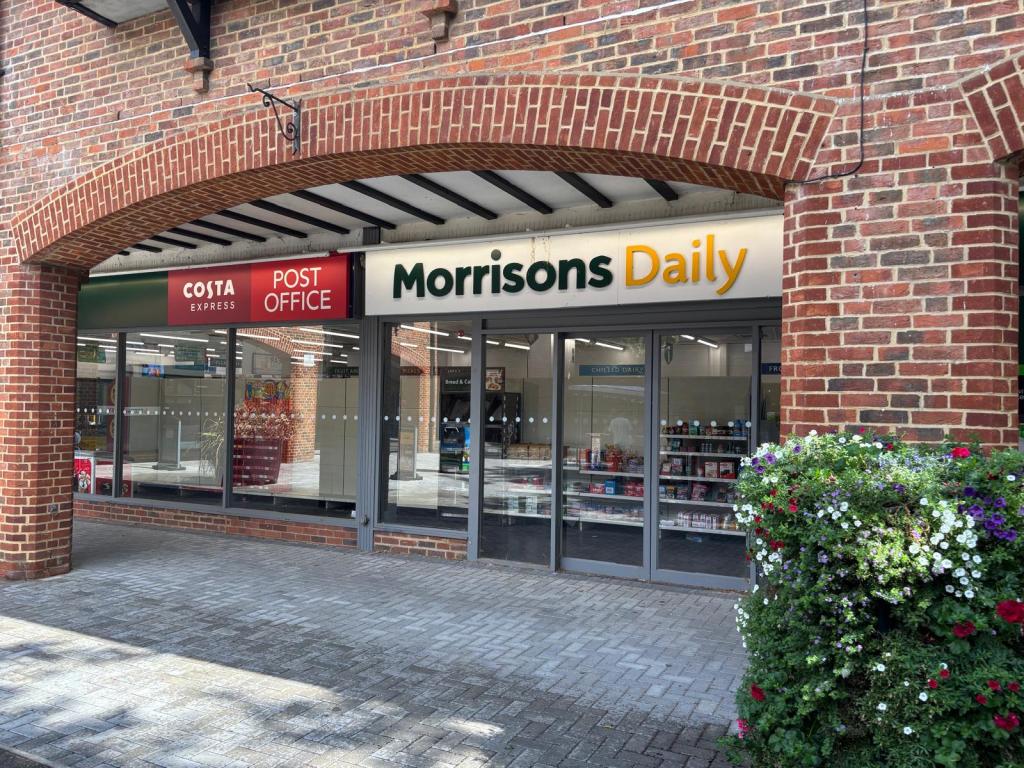
On 3 October, the Morrisons Daily on Consort Way will close its doors for the last time, and the Post Office counter inside it will close with them. Horley will be one of more than fifty communities across the country losing a branch this way, as Morrisons winds down its convenience stores and blames, in its own words, the rising cost of employing people.
I want to be fair to the company. A business that is losing money on a shop will eventually close that shop, and the staff on Consort Way are losing their jobs in all this too. My argument is not with Morrisons. It is with a system that allows a public service used by thousands of people to disappear as a side effect of a commercial decision made in a boardroom hundreds of miles away, with a few months’ notice and no plan for what comes next.
Because this is not really a story about parcels and stamps.
Over the past decade, Horley has watched its bank branches close one by one. It happened gradually, and the Post Office picked up the work. Under the arrangement between the Post Office and the banks, customers of almost every high street bank can walk into a Post Office and pay money in, draw money out, pay in cheques and check a balance. That counter on Consort Way has been doing the job of every bank that left.
Now it is going too, and what is left in the centre of Horley is one building society branch on Victoria Road. That branch serves its own members perfectly well. It is not, and was never meant to be, a banking service for a town of thirty thousand people.
If a replacement postmaster is not found, the nearest branch will be Meath Green Lane, about twenty minutes away in the north of the town. On a map that looks manageable. It looks rather different if you are eighty, if you use a walking frame, if you are pushing a buggy in the rain, or if you are a shopkeeper carrying a week’s takings on a bus.
Who actually gets left behind
We are drifting towards a cashless society, and we are doing it without anyone ever having voted for it. It is happening through a thousand small withdrawals of service, each one individually defensible and collectively enormous.
For most of us this barely registers, because we pay with a phone and think nothing of it. But there are people in Horley for whom cash is not a preference, it is the whole system. Older residents, many of whom have never used a banking app and are not about to start, particularly given the volume of fraud now aimed squarely at them. People on very tight budgets, who manage by physically separating money into envelopes and jars, and who know exactly where they stand at the end of the week because they can see it. People whose circumstances mean they need money that leaves no trail. And people who simply do not accept that every transaction they make should be recorded somewhere.
Telling those residents to go online is not an answer. It is a way of not answering.
There is a second group who get overlooked entirely in this, and that is our local businesses. A shop, a salon, a market trader or a sports club with a bar needs somewhere to deposit takings safely and to get change. Take that away and, sooner or later, they stop handling cash at all. And when that happens, the elderly customer who only carries cash finds she cannot shop on her own high street either.
That is how a cashless society actually arrives. Not by decision, but by attrition, starting with the people least able to complain about it.
The pressure the high street is under
I do not think you can talk about this closure honestly without talking about why running a shop in a Surrey town has become so hard.
Business rates are a tax you pay before you have sold a single thing. They are charged on the property you occupy, which means they fall hardest on precisely those businesses that must have a physical presence on a high street, and most lightly on those that operate out of a warehouse beside a motorway or out of no premises at all. A shop pays the same bill in a bad month as a good one.
April brought both a revaluation based on 2024 rental values and the new retail multipliers that replaced the temporary relief the high street had been living on since the pandemic. This was presented as help. Talk to shopkeepers in Horley and Dorking and you will find plenty who opened a bill this spring that was higher than the year before, not lower. Add the increase in the cost of employing staff, which Morrisons itself cited when it announced these closures, and the arithmetic of a small convenience store stops working.
If we want shops on our high streets, and post office counters inside those shops, we have to stop taxing them for existing. That means rebasing rates so the burden is shared more fairly with the online and distribution sectors, revaluing often enough that bills reflect reality rather than trailing years behind it, and giving councils real discretion to relieve the rates on a premises that takes on a community service.
What I am proposing
I did not want to write a piece that simply lists what is wrong. Here is what I think we should do:
1. A named replacement postmaster in Horley town centre, confirmed before 3 October. The Post Office has advertised the vacancy and is actively seeking a retailer to host a central branch. If you run a business in Horley with the space and the interest, applications go through runapostoffice.co.uk, and I will help you make the case for the site. The goal is no gap in service at all.
2. A formal access to cash review of Horley. LINK, the body that assesses whether communities have adequate access to cash, will accept a request from a resident, a community group, a councillor or an MP. Crucially, it can recommend a banking hub even in a town that still has one branch, if that branch does not meet the needs of local residents and businesses. Horley is exactly that case. I am submitting a request, and I am asking residents and businesses to add their names to it, because weight of numbers matters.
3. A banking hub in the centre of Horley. This is the real prize. A hub is a shared counter, owned by Cash Access UK and run by the Post Office, where customers of all the major banks can do their everyday banking, with community bankers from individual banks attending on rota days for anything more complicated. Where LINK recommends one and nothing else is in place, the service is expected to open within twelve weeks. Over two hundred towns already have one. There is no good reason Horley should not.
4. Something to cover the gap. October to the opening of a permanent solution is a long stretch if you are in your eighties. An outreach counter in a community venue for a few days a week, or a mobile service, would bridge it, and I want that on the table now rather than after people have started struggling.
5. A cash friendly Horley. I would like our businesses, our clubs and our public bodies to commit to continuing to accept cash, and to say so publicly in their windows. It costs nothing and it tells older residents that this town has not quietly decided to do without them.
What you can do
If you use the Post Office on Consort Way, for your pension, your bills, your banking or your business, I would like to hear from you. Send me a line about what you use it for and how far you would have to travel without it. Those accounts are what turns an argument into evidence, and evidence is what LINK, the Post Office and the banks respond to.
And if you run a retail business in Horley with a bit of space and an interest in the footfall a Post Office counter brings, please do get in touch. There is a real chance here for somebody, and a real service at stake for everybody else.
Horley is not a village that lost its shop. It is a town of thirty thousand people about to be left without a banking counter. That is fixable. Let us fix it.

